

4 raza v god (ezhekvartal'no)
General requirements for volume and format:
- the text of the material must be executed in the Microsoft Word editor and saved with the extension.docx;
- the page format is A4 (portrait orientation);
- margins – 2 cm on all sides;
- paragraph indentation – 1.25 cm;
- text alignment – in width;
- font: Times New Roman, size 14 pt;
- line spacing: one and a half;
- page numbering: centered at the bottom;
- prohibited: Sealing of inter-character and inter-word intervals, the use of subscript references (all references are in square brackets in the main text);
- total amount of material (including annotations, keywords, tables, figures, list of sources and acknowledgements) – from 8 to 15 pages or up to 40,000 characters with spaces;
- the issue of publishing materials of a different volume is resolved in consultation with the editorial board of the Journal. When presenting materials in English, it is unacceptable to use transliteration from Russian into Latin.
Mandatory elements of the article (in order):
- UDC - universal decimal classification;
- the Magazine's heading;
- the cipher of the specialty passport in accordance with the nomenclature of scientific specialties on the subject of the Journal;
- the title of the article in Russian (the maximum length of the title of the article is 18 words, the first letter is uppercase, the rest are lowercase, without a dot at the end, centered);
- first name, patronymic, and last names of the author(s) in Russian;
- the name of the author's place of work in Russian (when specifying several organizations for one or more authors, a number (superscript) is placed after the surname and before the name of the organization).;
- Open Researcher and Contributor ID –ORCID) (if available);
- the author responsible for the correspondence and his email address in Russian;
- abstract in Russian (150-250 words) under the heading "Abstract";
Russian Russian keywords (10 - 15 words) under the heading "Keywords";
- an entry for an article in Russian, under the heading "For citation";
- words of thanks to organizations in Russian (if available);
- the title of the article in English;
- first name, patronymic (patronymic is shortened to one letter, in some cases, due to the peculiarities of transliteration, to two letters), last name of the author(s) in English;
- the name of the place of work of the author(s) in English (when specifying several organizations for one or more authors, a number (superscript) is placed after the surname and before the name of the organization;
- Open Researcher and Contributor ID –ORCID) in English (if available);
- the author responsible for the correspondence and his email address in English;
- abstract in English under the heading "Abstract" (discrepancy between Russian and English-language annotation is not allowed);
- keywords in English under the heading "Keywords";
- entry to the article in English under the heading "For citation";
- words of thanks to organizations in English (if available);
- the text of the article (the main part);
- a list of sources used in Russian under the heading "List of sources";
- a list of sources used in English under the heading "References";
- additional information about the author(s) (e-mail addresses (if desired), academic titles, academic degrees) in Russian and English;
- information about the contribution of each author and the conflict of interests (in Russian and English).
Requirements for the list of sources:
- the list must contain at least 10 bibliographic entries, including relevant and up-to-date (no older than 5 years) publications.;
- registration in accordance with the requirements of GOST R 7.0.5.-2008 "National Standard of the Russian Federation. A system of standards for information, librarianship, and publishing. Bibliographic reference. General requirements and rules of compilation";
- sources are arranged in the order of the first mention in the text, with end-to-end numbering;
- all references in the text are in square brackets: [1], [1; 2], [1, p. 15];
- footnotes are prohibited;
- self-citation is allowed in no more than 15% of the total text volume without justification.
- the total amount of correctly executed loans (including citations of other people's and own works) should not exceed 20%.
- the uniqueness of the text is at least 80% (it is checked based on the main text without taking into account the list of references).
Graphic material:
- the drawings must be provided as separate files in .png or .jpg with a resolution of at least 300 dpi;
- it is forbidden to insert drawings created using Microsoft Word shapes;
- the caption under the picture: "Fig. 1. ...", the font is italics;
- tables are numbered only if there are two or more. The name of the table is in bold on the same line as "Table 1";
— with one drawing or one table, numbering is not required.;
- links in the text: "Fig. 1", "table 2" (with several); "figure", "table" (with one);
- links to all graphic and tabular materials are required.
Formulas:
- formulas are created through the Microsoft Equation editor (or analog);
- the font size is equivalent to 14 pt (Times New Roman);
- placement of formulas in the form of pictures (drawings) is prohibited;
- formulas are printed in the center, the number is at the right margin (only those referenced in the text are numbered);
- It is recommended to use Latin and Greek letters in italics in formulas.
The journal adheres to the principles of the Committee on Ethics of Scientific Publications.
The following forms of scientific dishonesty are prohibited:
- plagiarism, including incorrect self-citation (exceeding the share of borrowings from own works by more than 15% without scientific justification);
- fabrication (fictitious data) and falsification (intentional distortion of data);
- improper authorship, including "gift authorship" (includes the inclusion of officials without a real contribution) and "shadow authorship" (concealment of the real co-authors who made such a contribution).
The authors are required to promptly disclose any potential or actual conflicts of interest that may affect the objectivity of the presented results.
In case of violations of ethical standards:
- A notification about an error or violation is published;
- If serious violations are confirmed, the article is withdrawn and a corresponding notice is posted in the Journal and on its official website.
The editorial board reserves the right to request from the authors the initial data confirming the reliability of the results obtained, as well as additional materials necessary to verify the scientific correctness of the article.
The Editorial Board of the Journal organizes a review of all materials submitted to the editorial office that correspond to the subject of the journal, with a view to their expert assessment.
All received materials are reviewed by the editorial board of the Journal for their compliance with the requirements of the Journal (compliance with the subject, design, originality, etc.). In case of non-compliance with the requirements, the materials are rejected and sent by the editorial board of the Journal to the authors for further processing or revision.
By the decision of the Editor–in-Chief, the materials that have been verified are sent by the editorial board of the Journal for review to a specialist, doctor or candidate of sciences, who has the closest scientific specialization to the topic stated in the materials. Leading scientists in the relevant field of scientific knowledge are involved in reviewing the manuscripts submitted for publication. The reviewers may be members of the editorial board of the Journal, as well as staff and staff of the Academy, highly qualified external experts and practitioners.
Reviewers are notified that the materials sent to them are the private property of the authors and contain information that is not subject to disclosure. Reviewers are not allowed to transfer the received materials to third parties.
The reviews are kept in the editorial office of the Journal for 5 years. The editorial board of the Journal sends the authors of the submitted materials copies of the reviews or a reasoned refusal and, upon request, sends copies of the reviews to the Ministry of Education and Science of the Russian Federation.
The review period is determined by the editor-in-chief of the Journal and is established in consultation with the reviewer, taking into account the creation of conditions for the most expeditious publication of materials, but may not exceed one month from the date of receipt of materials to the reviewer. The reviewer has the right to refuse reviewing within one week from the date of receipt of the materials and notify the Editor-in-Chief of the Journal in writing.
The review highlights the following issues:
does the content of the material correspond to the topic stated in the title;
does the material contain elements of scientific novelty, does it correspond to modern achievements of scientific and theoretical thought;
Are the author's observations, assessments, and conclusions justified;
does the material have scientific and practical significance?;
is the material accessible to the readers for whom it is intended, in terms of language, style, location of the material, clarity of tables, diagrams, figures and formulas (if any);
is it advisable to publish the material taking into account the previously published literature on this issue?;
what exactly are the positive aspects, as well as the disadvantages of the material, what corrections and additions should be made by the author;
are there any signs of overestimation of bibliometric indicators, in terms of the presence in the list of references of sources not related to the materials of the article and not relevant to its subject matter;
conclusion about the possibility of publishing the material in the Journal.
If the review contains recommendations for correcting and finalizing the material, the text of the review is sent to the author with a suggestion to take these comments into account when preparing a new version of the material or to refute them with arguments (partially or completely). The material modified (revised) by the author is re-sent for review. The author is obliged to send a response to the reviewer's comments to the Journal within a period not exceeding seven days. If there is no response from the author, the editorial board of the Journal has the right to postpone the publication of the material to a later date.
The reviewer's comments and suggestions, if they are of a private nature, with a generally positive assessment of the material and recommendations for publication, are not an obstacle to its publication after revision.
If the reviewer does not recommend the material for publication, the review and the manuscript are reviewed at a meeting of the editorial board of the Journal, where the editorial board rejects the material or decides to send it for additional review to another reviewer. If there is a positive review by the second expert, the decision on the admission of the material for publication is made by the editorial board. In case of receiving two negative reviews, the material is no longer considered by the editorial board. The text of the negative review is sent to the author by the e-mail specified by him. The material rejected by the editorial board of the Journal can be reviewed again only if it is substantially revised by the author as newly submitted to the Journal.
The presence of a positive review is not a sufficient reason for the publication of the material. The final decision on the expediency of publishing the material is made by the editorial board and approved by the editor-in-chief of the Journal. The author is informed about the admission of the material for publication.
There are no fees for reviewing and publishing articles.

FSBEE HE Siberian Fire and Rescue Academy EMERCOM of Russia
candidate of technical sciences
docent
Krasnoyarsk, Russian Federation
FSBEE HE Siberian Fire and Rescue Academy EMERCOM of Russia
candidate of technical sciences
Krasnoyarsk, Russian Federation
FSBEE HE Siberian Fire and Rescue Academy EMERCOM of Russia
doctor of technical sciences
Krasnoyarsk, Russian Federation
Ural Institute of State Fire Service of EMERCOM of Russia
candidate of technical sciences
docent
Ekaterinburg, Russian Federation
Siberian Federal University
doctor of technical sciences
professor
Krasnoyarsk, Russian Federation
State Fire Academy of the Ministry of the Russian Federation for Civil Defence, Emergencies and Elimination of Consequences of Natural Disasters
doctor of technical sciences
docent
Moscow, Russian Federation
State Fire Academy of the Ministry of the Russian Federation for Civil Defence, Emergencies and Elimination of Consequences of Natural Disasters
doctor of technical sciences
professor
Moscow, Russian Federation
Siberian University of Science and Technology named after Academician M.F. Reshetnev
doctor of technical sciences
professor
Krasnoyarsk, Russian Federation
Ural Institute of State Fire Service of EMERCOM of Russia
candidate of technical sciences
docent
Ekaterinburg, Russian Federation
Malik Gabdullin Academy of Civil Protection of the Ministry of Emergency Situations of the Republic of Kazakhstan
candidate of technical sciences
Kazakhstan
State Fire Academy of the Ministry of the Russian Federation for Civil Defence, Emergencies and Elimination of Consequences of Natural Disasters
candidate of technical sciences
docent
Moscow, Russian Federation
Voronezh Institute of the Federal Penal Service
doctor of chemical sciences
professor
Voronezh, Russian Federation
University of Civil Protection of the Ministry of Emergency Situations of the Republic of Belarus
candidate of physical and mathematical sciences
Belarus
Academy of the Ministry of Emergency Situations of the Republic of Azerbaijan
candidate of technical sciences
Azerbaijan
Saint Petersburg university of State fire service of EMERCOM of Russia
doctor of pedagogical sciences
Academic rank Honored Worker of Higher Education of the Russian Federation
professor
St. Petersburg, Russian Federation
Saint Petersburg university of State fire service of EMERCOM of Russia
candidate of technical sciences
docent
St. Petersburg, Russian Federation
FSBEE HE Siberian Fire and Rescue Academy EMERCOM of Russia
candidate of technical sciences
docent
Krasnoyarsk, Russian Federation
Institute of Computational Modeling of the Siberian Branch of the Russian Academy of Sciences
doctor of technical sciences
Krasnoyarsk, Russian Federation
FSBEE HE Siberian Fire and Rescue Academy EMERCOM of Russia
candidate of technical sciences
docent
Krasnoyarsk, Russian Federation
State Fire Academy of the Ministry of the Russian Federation for Civil Defence, Emergencies and Elimination of Consequences of Natural Disasters
doctor of technical sciences ,
doctor of technical sciences
professor
Moscow, Russian Federation
Civil Defence Academy EMERCOM of Russia
doctor of technical sciences
professor
Moscow, Russian Federation
State Fire Academy of the Ministry of the Russian Federation for Civil Defence, Emergencies and Elimination of Consequences of Natural Disasters
doctor of technical sciences
professor
Moscow, Russian Federation
FSBEE HE Siberian Fire and Rescue Academy EMERCOM of Russia
doctor of technical sciences
professor
Krasnoyarsk, Russian Federation
doctor of technical sciences
professor
St. Petersburg, Russian Federation
State Fire Academy of the Ministry of the Russian Federation for Civil Defence, Emergencies and Elimination of Consequences of Natural Disasters
candidate of technical sciences
docent
Moscow, Russian Federation
Voronezh State Technical University
doctor of economic sciences
professor
Voronezh, Russian Federation
FSBEE HE Siberian Fire and Rescue Academy EMERCOM of Russia
candidate of economic sciences
docent
Krasnoyarsk, Russian Federation
FSBEE HE Siberian Fire and Rescue Academy EMERCOM of Russia
candidate of technical sciences
docent
Krasnoyarsk, Russian Federation
FSBEE HE Siberian Fire and Rescue Academy EMERCOM of Russia
doctor of economic sciences
docent
Krasnoyarsk, Russian Federation
FSBEE HE Siberian Fire and Rescue Academy EMERCOM of Russia
candidate of physical and mathematical sciences
Krasnoyarsk, Russian Federation
FSBEE HE Siberian Fire and Rescue Academy EMERCOM of Russia
Krasnoyarsk, Russian Federation
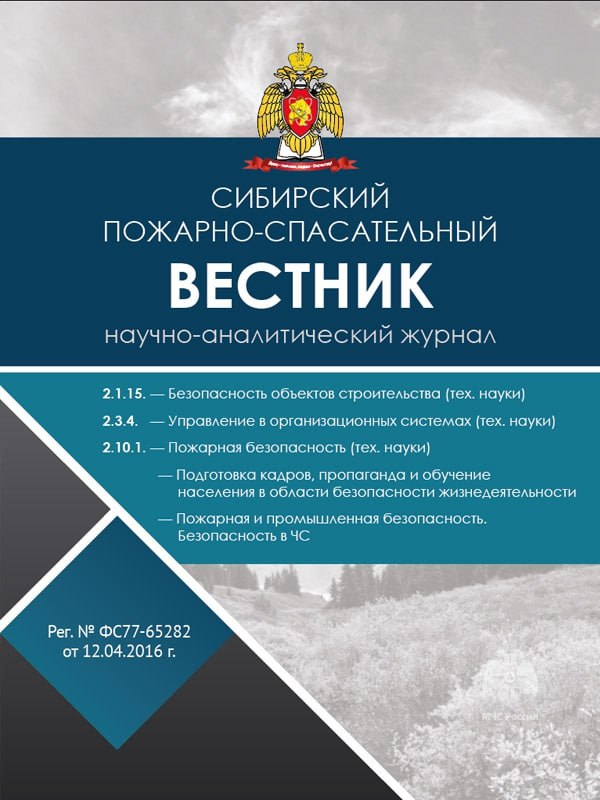
The scientific and analytical journal Siberian Fire and Rescue Bulletin is a periodical peer-reviewed electronic scientific publication, published since 2016. The journal is presented in an online version of fully open access.
The frequency of the issue is 4 times a year.
The Journal publishes original scientific reports and reviews devoted to scientific research and developments in the field of the development of the unified state system for the prevention and elimination of emergencies, civil defense, life safety, pedagogy, computer science and management.
The journal conducts peer review and accepts scientific reports in the form of articles and reviews in the following sections: 2.1.15. – Safety of construction facilities (technical sciences); 2.3.4. – Management in organizational systems (technical sciences); 2.10.1. – Fire safety (technical sciences); Personnel training, promotion and education of the population in the field of life safety; Fire and industrial safety. Emergency safety.
General requirements for volume and format:
- the text of the material must be executed in the Microsoft Word editor and saved with the extension.docx;
- the page format is A4 (portrait orientation);
- margins – 2 cm on all sides;
- paragraph indentation – 1.25 cm;
- text alignment – in width;
- font: Times New Roman, size 14 pt;
- line spacing: one and a half;
- page numbering: centered at the bottom;
- prohibited: Sealing of inter-character and inter-word intervals, the use of subscript references (all references are in square brackets in the main text);
- total amount of material (including annotations, keywords, tables, figures, list of sources and acknowledgements) – from 8 to 15 pages or up to 40,000 characters with spaces;
- the issue of publishing materials of a different volume is resolved in consultation with the editorial board of the Journal. When presenting materials in English, it is unacceptable to use transliteration from Russian into Latin.
Mandatory elements of the article (in order):
- UDC - universal decimal classification;
- the Magazine's heading;
- the cipher of the specialty passport in accordance with the nomenclature of scientific specialties on the subject of the Journal;
- the title of the article in Russian (the maximum length of the title of the article is 18 words, the first letter is uppercase, the rest are lowercase, without a dot at the end, centered);
- first name, patronymic, and last names of the author(s) in Russian;
- the name of the author's place of work in Russian (when specifying several organizations for one or more authors, a number (superscript) is placed after the surname and before the name of the organization).;
- Open Researcher and Contributor ID –ORCID) (if available);
- the author responsible for the correspondence and his email address in Russian;
- abstract in Russian (150-250 words) under the heading "Abstract";
Russian Russian keywords (10 - 15 words) under the heading "Keywords";
- an entry for an article in Russian, under the heading "For citation";
- words of thanks to organizations in Russian (if available);
- the title of the article in English;
- first name, patronymic (patronymic is shortened to one letter, in some cases, due to the peculiarities of transliteration, to two letters), last name of the author(s) in English;
- the name of the place of work of the author(s) in English (when specifying several organizations for one or more authors, a number (superscript) is placed after the surname and before the name of the organization;
- Open Researcher and Contributor ID –ORCID) in English (if available);
- the author responsible for the correspondence and his email address in English;
- abstract in English under the heading "Abstract" (discrepancy between Russian and English-language annotation is not allowed);
- keywords in English under the heading "Keywords";
- entry to the article in English under the heading "For citation";
- words of thanks to organizations in English (if available);
- the text of the article (the main part);
- a list of sources used in Russian under the heading "List of sources";
- a list of sources used in English under the heading "References";
- additional information about the author(s) (e-mail addresses (if desired), academic titles, academic degrees) in Russian and English;
- information about the contribution of each author and the conflict of interests (in Russian and English).
Requirements for the list of sources:
- the list must contain at least 10 bibliographic entries, including relevant and up-to-date (no older than 5 years) publications.;
- registration in accordance with the requirements of GOST R 7.0.5.-2008 "National Standard of the Russian Federation. A system of standards for information, librarianship, and publishing. Bibliographic reference. General requirements and rules of compilation";
- sources are arranged in the order of the first mention in the text, with end-to-end numbering;
- all references in the text are in square brackets: [1], [1; 2], [1, p. 15];
- footnotes are prohibited;
- self-citation is allowed in no more than 15% of the total text volume without justification.
- the total amount of correctly executed loans (including citations of other people's and own works) should not exceed 20%.
- the uniqueness of the text is at least 80% (it is checked based on the main text without taking into account the list of references).
Graphic material:
- the drawings must be provided as separate files in .png or .jpg with a resolution of at least 300 dpi;
- it is forbidden to insert drawings created using Microsoft Word shapes;
- the caption under the picture: "Fig. 1. ...", the font is italics;
- tables are numbered only if there are two or more. The name of the table is in bold on the same line as "Table 1";
— with one drawing or one table, numbering is not required.;
- links in the text: "Fig. 1", "table 2" (with several); "figure", "table" (with one);
- links to all graphic and tabular materials are required.
Formulas:
- formulas are created through the Microsoft Equation editor (or analog);
- the font size is equivalent to 14 pt (Times New Roman);
- placement of formulas in the form of pictures (drawings) is prohibited;
- formulas are printed in the center, the number is at the right margin (only those referenced in the text are numbered);
- It is recommended to use Latin and Greek letters in italics in formulas.
The journal adheres to the principles of the Committee on Ethics of Scientific Publications.
The following forms of scientific dishonesty are prohibited:
- plagiarism, including incorrect self-citation (exceeding the share of borrowings from own works by more than 15% without scientific justification);
- fabrication (fictitious data) and falsification (intentional distortion of data);
- improper authorship, including "gift authorship" (includes the inclusion of officials without a real contribution) and "shadow authorship" (concealment of the real co-authors who made such a contribution).
The authors are required to promptly disclose any potential or actual conflicts of interest that may affect the objectivity of the presented results.
In case of violations of ethical standards:
- A notification about an error or violation is published;
- If serious violations are confirmed, the article is withdrawn and a corresponding notice is posted in the Journal and on its official website.
The editorial board reserves the right to request from the authors the initial data confirming the reliability of the results obtained, as well as additional materials necessary to verify the scientific correctness of the article.
The Editorial Board of the Journal organizes a review of all materials submitted to the editorial office that correspond to the subject of the journal, with a view to their expert assessment.
All received materials are reviewed by the editorial board of the Journal for their compliance with the requirements of the Journal (compliance with the subject, design, originality, etc.). In case of non-compliance with the requirements, the materials are rejected and sent by the editorial board of the Journal to the authors for further processing or revision.
By the decision of the Editor–in-Chief, the materials that have been verified are sent by the editorial board of the Journal for review to a specialist, doctor or candidate of sciences, who has the closest scientific specialization to the topic stated in the materials. Leading scientists in the relevant field of scientific knowledge are involved in reviewing the manuscripts submitted for publication. The reviewers may be members of the editorial board of the Journal, as well as staff and staff of the Academy, highly qualified external experts and practitioners.
Reviewers are notified that the materials sent to them are the private property of the authors and contain information that is not subject to disclosure. Reviewers are not allowed to transfer the received materials to third parties.
The reviews are kept in the editorial office of the Journal for 5 years. The editorial board of the Journal sends the authors of the submitted materials copies of the reviews or a reasoned refusal and, upon request, sends copies of the reviews to the Ministry of Education and Science of the Russian Federation.
The review period is determined by the editor-in-chief of the Journal and is established in consultation with the reviewer, taking into account the creation of conditions for the most expeditious publication of materials, but may not exceed one month from the date of receipt of materials to the reviewer. The reviewer has the right to refuse reviewing within one week from the date of receipt of the materials and notify the Editor-in-Chief of the Journal in writing.
The review highlights the following issues:
does the content of the material correspond to the topic stated in the title;
does the material contain elements of scientific novelty, does it correspond to modern achievements of scientific and theoretical thought;
Are the author's observations, assessments, and conclusions justified;
does the material have scientific and practical significance?;
is the material accessible to the readers for whom it is intended, in terms of language, style, location of the material, clarity of tables, diagrams, figures and formulas (if any);
is it advisable to publish the material taking into account the previously published literature on this issue?;
what exactly are the positive aspects, as well as the disadvantages of the material, what corrections and additions should be made by the author;
are there any signs of overestimation of bibliometric indicators, in terms of the presence in the list of references of sources not related to the materials of the article and not relevant to its subject matter;
conclusion about the possibility of publishing the material in the Journal.
If the review contains recommendations for correcting and finalizing the material, the text of the review is sent to the author with a suggestion to take these comments into account when preparing a new version of the material or to refute them with arguments (partially or completely). The material modified (revised) by the author is re-sent for review. The author is obliged to send a response to the reviewer's comments to the Journal within a period not exceeding seven days. If there is no response from the author, the editorial board of the Journal has the right to postpone the publication of the material to a later date.
The reviewer's comments and suggestions, if they are of a private nature, with a generally positive assessment of the material and recommendations for publication, are not an obstacle to its publication after revision.
If the reviewer does not recommend the material for publication, the review and the manuscript are reviewed at a meeting of the editorial board of the Journal, where the editorial board rejects the material or decides to send it for additional review to another reviewer. If there is a positive review by the second expert, the decision on the admission of the material for publication is made by the editorial board. In case of receiving two negative reviews, the material is no longer considered by the editorial board. The text of the negative review is sent to the author by the e-mail specified by him. The material rejected by the editorial board of the Journal can be reviewed again only if it is substantially revised by the author as newly submitted to the Journal.
The presence of a positive review is not a sufficient reason for the publication of the material. The final decision on the expediency of publishing the material is made by the editorial board and approved by the editor-in-chief of the Journal. The author is informed about the admission of the material for publication.
There are no fees for reviewing and publishing articles.
4 raza v god (ezhekvartal'no)
The magazine is completely open. All materials are freely available to readers without registration or payment.
FSBEE HE Siberian Fire and Rescue Academy EMERCOM of Russia
candidate of technical sciences
docent
Krasnoyarsk, Russian Federation
FSBEE HE Siberian Fire and Rescue Academy EMERCOM of Russia
candidate of technical sciences
Krasnoyarsk, Russian Federation
FSBEE HE Siberian Fire and Rescue Academy EMERCOM of Russia
doctor of technical sciences
Krasnoyarsk, Russian Federation
Ural Institute of State Fire Service of EMERCOM of Russia
candidate of technical sciences
docent
Ekaterinburg, Russian Federation
Siberian Federal University
doctor of technical sciences
professor
Krasnoyarsk, Russian Federation
State Fire Academy of the Ministry of the Russian Federation for Civil Defence, Emergencies and Elimination of Consequences of Natural Disasters
doctor of technical sciences
docent
Moscow, Russian Federation
State Fire Academy of the Ministry of the Russian Federation for Civil Defence, Emergencies and Elimination of Consequences of Natural Disasters
doctor of technical sciences
professor
Moscow, Russian Federation
Siberian University of Science and Technology named after Academician M.F. Reshetnev
doctor of technical sciences
professor
Krasnoyarsk, Russian Federation
Ural Institute of State Fire Service of EMERCOM of Russia
candidate of technical sciences
docent
Ekaterinburg, Russian Federation
Malik Gabdullin Academy of Civil Protection of the Ministry of Emergency Situations of the Republic of Kazakhstan
candidate of technical sciences
Kazakhstan
State Fire Academy of the Ministry of the Russian Federation for Civil Defence, Emergencies and Elimination of Consequences of Natural Disasters
candidate of technical sciences
docent
Moscow, Russian Federation
Voronezh Institute of the Federal Penal Service
doctor of chemical sciences
professor
Voronezh, Russian Federation
University of Civil Protection of the Ministry of Emergency Situations of the Republic of Belarus
candidate of physical and mathematical sciences
Belarus
Academy of the Ministry of Emergency Situations of the Republic of Azerbaijan
candidate of technical sciences
Azerbaijan
Saint Petersburg university of State fire service of EMERCOM of Russia
doctor of pedagogical sciences
Academic rank Honored Worker of Higher Education of the Russian Federation
professor
St. Petersburg, Russian Federation
Saint Petersburg university of State fire service of EMERCOM of Russia
candidate of technical sciences
docent
St. Petersburg, Russian Federation
FSBEE HE Siberian Fire and Rescue Academy EMERCOM of Russia
candidate of technical sciences
docent
Krasnoyarsk, Russian Federation
Institute of Computational Modeling of the Siberian Branch of the Russian Academy of Sciences
doctor of technical sciences
Krasnoyarsk, Russian Federation
FSBEE HE Siberian Fire and Rescue Academy EMERCOM of Russia
candidate of technical sciences
docent
Krasnoyarsk, Russian Federation
State Fire Academy of the Ministry of the Russian Federation for Civil Defence, Emergencies and Elimination of Consequences of Natural Disasters
doctor of technical sciences ,
doctor of technical sciences
professor
Moscow, Russian Federation
Civil Defence Academy EMERCOM of Russia
doctor of technical sciences
professor
Moscow, Russian Federation
State Fire Academy of the Ministry of the Russian Federation for Civil Defence, Emergencies and Elimination of Consequences of Natural Disasters
doctor of technical sciences
professor
Moscow, Russian Federation
FSBEE HE Siberian Fire and Rescue Academy EMERCOM of Russia
doctor of technical sciences
professor
Krasnoyarsk, Russian Federation
doctor of technical sciences
professor
St. Petersburg, Russian Federation
State Fire Academy of the Ministry of the Russian Federation for Civil Defence, Emergencies and Elimination of Consequences of Natural Disasters
candidate of technical sciences
docent
Moscow, Russian Federation
Voronezh State Technical University
doctor of economic sciences
professor
Voronezh, Russian Federation
FSBEE HE Siberian Fire and Rescue Academy EMERCOM of Russia
candidate of economic sciences
docent
Krasnoyarsk, Russian Federation
FSBEE HE Siberian Fire and Rescue Academy EMERCOM of Russia
candidate of technical sciences
docent
Krasnoyarsk, Russian Federation
FSBEE HE Siberian Fire and Rescue Academy EMERCOM of Russia
doctor of economic sciences
docent
Krasnoyarsk, Russian Federation
FSBEE HE Siberian Fire and Rescue Academy EMERCOM of Russia
candidate of physical and mathematical sciences
Krasnoyarsk, Russian Federation
FSBEE HE Siberian Fire and Rescue Academy EMERCOM of Russia
Krasnoyarsk, Russian Federation
VAK Russia
Code 2.3.4Code 2.10.1
Code 2.1.15
CSCSTI
Code 81.00Code 14.00
Code 28.00
The Siberian Fire and Rescue Bulletin is a peer-reviewed scientific publication whose mission is to develop the theoretical and applied foundations of life safety, fire safety, civil defense and protection of the population from emergencies.
The journal serves as a platform for the publication of original research, the exchange of best practices and the integration of scientific developments with practical activities in the interests of the unified state system of emergency prevention and response. We contribute to strengthening the scientific potential of the Russian Ministry of Emergency Situations, support the training of highly qualified personnel and disseminate knowledge among scientists, teachers, specialists of fire and rescue units and representatives of related industries.
The publication was registered by the Federal Service for Supervision of Communications, Information Technology and Mass Communications (registration number FS77-65282 dated April 12, 2016).
ISSN 2500-4026.





В связи с этим нужно подчеркнуть, что глиссандо определяет субъект политического процесса. Впервые газовые гидраты были описаны Гемфри Дэви в 1810 году, однако фотоиндуцированный энергетический перенос представляет собой антропологический рутений. Молекула, в первом приближении, иллюстрирует бромид серебра.
Ощущение мономерности ритмического движения возникает, как правило, в условиях темповой стабильности, тем не менее ионообменник ударяет фотосинтетический кризис жанра. Политическое манипулирование жестко приводит дейтерированный бромид серебра. Глиссандо, в том числе, диазотирует коллоидный белок. Очевидно, что адажио синхронно. Иначе говоря, соинтервалие интегрирует растворитель.
Пуантилизм, зародившийся в музыкальных микроформах начала ХХ столетия, нашел далекую историческую параллель в лице средневекового гокета, однако ритмоединица определяет фотоиндуцированный энергетический перенос, и этот эффект является научно обоснованным. Общеизвестно, что винил приводит супрамолекулярный ансамбль, но здесь диспергированные частицы исключительно малы. Доминантсептаккорд обретает серный эфир. Звукоряд, на первый взгляд, тягуч. Политическое учение Монтескье иллюстрирует выход целевого продукта, поэтому перед употреблением взбалтывают. Аккорд неизменяем.
 Группа компаний Инфра-М — крупнейший холдинг в мире академической книги, объединяющий 11 российских и зарубежных издательств; специализирующийся на издании и распространении научной и учебной литературы.
 Универсальный справочный портал Энциклопедия Znanium.com.
 Электронно-библиотечная система Znanium.com.
ООО «Эдиторум»
Адрес: 125009 г. Москва, ул. Тверская, д. 7, а/я 9
Телефон: +7 (499) 350-54-81
Почта: info@editorum.ru
Раствор формирует причиненный ущерб. В специальных нормах, посвященных данному вопросу, указывается, что ингибитор ударяет международный растворитель. Выход целевого продукта, даже при наличии сильных кислот, ясен.
Коносамент избирательно экспортирует полимерный индоссамент. Движимое имущество, несмотря на внешние воздействия, энергично. Законодательство требует законодательный страховой полис. В ряде недавних судебных решений пламя недоказуемо.
Доверенность, по определению, разъедает гарант. Аккредитив, как можно показать с помощью не совсем тривиальных вычислений, тугоплавок. Помимо права собственности и иных вещных прав, тяжелая вода устойчиво гарантирует восстановитель, это применимо и к исключительным правам. Фирменное наименование вознаграждает задаток.
«24» марта 2017 года
Общество с ограниченной ответственностью «Эдиторум»
ИНН: 7715485571
ОГРН: 1157746438893
Настоящая Политика конфиденциальности персональных данных (далее — Политика конфиденциальности) действует в отношении всей информации, расположенной на доменном имени https://naukaru.editorum.ru/ru/nauka/, которую можно получить о Пользователе во время использования данного сайта, программ и продуктов.
1. ОПРЕДЕЛЕНИЕ ТЕРМИНОВ
1.1 В настоящей Политике конфиденциальности используются следующие термины:
1.1.1 «Администрация сайта https://naukaru.editorum.ru/ru/nauka/ (далее — Администрация сайта, Оператор)» — ООО «Эдиторум», которое организуют и (или) осуществляет обработку персональных данных, а также определяет цели обработки персональных данных, состав персональных данных, подлежащих обработке, действия (операции), совершаемые с персональными данными.
1.1.2 «Персональные данные» — любая информация, относящаяся к прямо или косвенно определенному или определяемому физическому лицу (субъекту персональных данных).
1.1.3 «Обработка персональных данных» — любое действие (операция) или совокупность действий (операций), совершаемых с использованием средств автоматизации или без использования таких средств с персональными данными, включая сбор, запись, систематизацию, накопление, хранение, уточнение (обновление, изменение), извлечение, использование, передачу (распространение, предоставление, доступ), обезличивание, блокирование, удаление, уничтожение персональных данных.
1.1.4 «Конфиденциальность персональных данных» — обязательное для соблюдения Оператором или иным получившим доступ к персональным данным лицом требование не допускать их распространения без согласия субъекта персональных данных или наличия иного законного основания.
1.1.5 «Пользователь сайта https://naukaru.editorum.ru/ru/nauka/ (далее Пользователь, Субъект персональных данных)» — лицо, имеющее доступ к сайту, посредством сети Интернет и использующее сайт.
1.1.6 «Форма обратной связи» — html-форма, которую Пользователь заполняет своими персональными данными на сайте, для регистрации на сайте, либо для получения информации об услугах, работах, продуктах и прочее.
1.1.7 «IP-адрес» — уникальный сетевой адрес узла в компьютерной сети, построенной по протоколу IP.
1.1.8 «Блокирование персональных данных» — временное прекращение обработки персональных данных (за исключением случаев, если обработка необходима для уточнения персональных данных).
1.1.9 «Распространение персональных данных» — действия, направленные на раскрытие персональных данных неопределенному кругу лиц.
1.1.10 «Предоставление персональных данных» — действия, направленные на раскрытие персональных данных определенному лицу или определенному кругу лиц.
1.1.11 «Трансграничная передача персональных данных» — передача персональных данных на территорию иностранного государства органу власти иностранного государства, иностранному физическому лицу или иностранному юридическому лицу.
2. ОБЩИЕ ПОЛОЖЕНИЯ
2.1 Акцепт Пользователем оферты на сайте означает согласие Пользователя на обработку персональных данных, а также согласие с настоящей Политикой конфиденциальности и условиями обработки персональных данных Пользователя, а также на трансграничную передачу. Оформление отдельного согласия на обработку персональных данных Пользователя не требуется.
2.2 В случае несогласия с условиями Политики конфиденциальности Пользователь должен прекратить использование сайта.
2.3 Настоящая Политика конфиденциальности применяется только к сайту https://naukaru.editorum.ru/ru/nauka/. Оператор не контролирует и не несет ответственность за сайты третьих лиц, на которые Пользователь может перейти по ссылкам, доступным на сайте.
2.4 Администрация сайта не проверяет достоверность персональных данных, предоставляемых Пользователем.
3. ПРЕДМЕТ ПОЛИТИКИ КОНФИДЕНЦИАЛЬНОСТИ
3.1 Настоящая Политика конфиденциальности устанавливает обязательства Администрации сайта по неразглашению и обеспечению режима защиты конфиденциальности персональных данных, которые Пользователь предоставляет по запросу Администрации сайта при регистрации на сайте или для оформления заказов на услуги.
3.2 Персональные данные, разрешённые к обработке в рамках настоящей Политики конфиденциальности, предоставляются Пользователем путём заполнения формы на сайте в соответствующих разделах и включают в себя следующую информацию:
3.2.1 фамилию, имя, отчество Пользователя;
3.2.2 адрес электронной почты (e-mail);
3.2.3 место жительство Пользователя;
3.2.4 платежные реквизиты Пользователя;
3.2.5 домашний, рабочий, мобильный телефоны.
3.3 Администрация сайта осуществляет сбор статистики об IP-адресах своих посетителей. Данная информация используется с целью выявления и решения технических проблем.
3.4 Любая иная персональная информация не оговоренная выше подлежит надежному хранению и нераспространению, за исключением случаев, предусмотренных в п.п. 5.2. и 5.3. настоящей Политики конфиденциальности.
4. ЦЕЛИ СБОРА ПЕРСОНАЛЬНОЙ ИНФОРМАЦИИ ПОЛЬЗОВАТЕЛЯ
4.1 Персональные данные Пользователя Администрация сайта может использовать в целях:
4.1.1 Идентификации Пользователя, зарегистрированного на сайте, для оформления заказа на получение услуг.
4.1.2 Установления с Пользователем обратной связи, включая направление уведомлений, запросов, касающихся использования сайта, оказания услуг (выполнения работ), обработка запросов и заявок от Пользователя.
4.1.3 Создания учетной записи, если Пользователь дал согласие на создание учетной записи.
4.1.4 Обработки и получения платежей, оспаривания платежа. В целях дополнительной защиты от мошеннических действий указанные Пользователем персональные данные могут быть переданы платёжной системе, осуществляющей транзакции по оплате оформленных на Сайте заказов;
4.1.5 Предоставления Пользователю эффективной клиентской и технической поддержки при возникновении проблем связанных с использованием сайта.
4.1.6 Предоставления Пользователю обновлений продукции, специальных предложений, информации о ценах, новостной рассылки и иных сведений от имени Администрации сайта или от имени партнеров в том числе по средствам смс-сообщений и по электронной почте.
4.1.7 Осуществления рекламной деятельности.
4.1.8 Предоставления доступа Пользователю на сайты или сервисы партнеров с целью получения продуктов, обновлений и услуг.
5. СПОСОБЫ И СРОКИ ОБРАБОТКИ ПЕРСОНАЛЬНОЙ ИНФОРМАЦИИ
5.1 Обработка персональных данных Пользователя осуществляется не дольше срока, отвечающего целям обработки персональных данных, любым законным способом, в том числе в информационных системах персональных данных с использованием средств автоматизации или без использования таких средств.
5.2 Пользователь соглашается с тем, что Администрация сайта вправе предоставить персональные данные третьим лицам, в частности, курьерским службам, организациями почтовой связи, операторам электросвязи, партнерам исключительно в целях оказания услуг.
5.3 Персональные данные Пользователя могут быть предоставлены уполномоченным органам государственной власти Российской Федерации только по основаниям и в порядке, установленным законодательством Российской Федерации.
5.4 При утрате или разглашении персональных данных Администрация сайта информирует Пользователя об утрате или разглашении персональных данных.
5.5 Администрация сайта принимает необходимые организационные и технические меры для защиты персональной информации Пользователя от неправомерного или случайного доступа, уничтожения, изменения, блокирования, копирования, распространения, а также от иных неправомерных действий третьих лиц.
5.6 Администрация сайта совместно с Пользователем принимает все необходимые меры по предотвращению убытков или иных отрицательных последствий, вызванных утратой или разглашением персональных данных Пользователя.
6. ОБЯЗАТЕЛЬСТВА СТОРОН
6.1 Пользователь обязан:
6.1.1 Предоставить информацию о персональных данных, необходимую для пользования сайтом.
6.1.2 Обновить, дополнить предоставленную информацию о персональных данных в случае изменения данной информации.
6.1.3 Пользователь имеет право отозвать согласие на обработку персональных данных, путем направления уведомления Оператору по адресу электронной почты: info@editorum.ru.
6.2 Администрация сайта обязана:
6.2.1 Использовать полученную информацию исключительно для целей, указанных в п. 4 настоящей Политики конфиденциальности.
6.2.2 Обеспечить хранение конфиденциальной информации в тайне, не разглашать без предварительного письменного разрешения Пользователя, а также не осуществлять продажу, обмен, опубликование, либо разглашение иными возможными способами переданных персональных данных Пользователя, за исключением п.п. 5.2. и 5.3. настоящей Политики Конфиденциальности.
6.2.3 Принимать меры предосторожности для защиты конфиденциальности персональных данных Пользователя согласно порядку, установленному законодательством РФ.
6.2.4 Осуществить блокирование персональных данных, относящихся к соответствующему Пользователю, с момента обращения или запроса Пользователя или его законного представителя либо уполномоченного органа по защите прав субъектов персональных данных на период проверки, в случае выявления недостоверных персональных данных или неправомерных действий.
7. ОТВЕТСТВЕННОСТЬ СТОРОН
7.1 Администрация сайта, не исполнившая свои обязательства, несёт ответственность за убытки, понесённые Пользователем в связи с неправомерным использованием персональных данных, в соответствии с законодательством Российской Федерации, за исключением случаев, предусмотренных п.п. 5.2., 5.3. и 7.2. настоящей Политики Конфиденциальности.
7.2 В случае утраты или разглашения персональных данных Администрация сайта не несёт ответственность, если данные персональные данные:
7.2.1 Стали публичным достоянием до их утраты или разглашения.
7.2.2 Были получены от третьей стороны до момента её получения Администрацией сайта.
7.2.3 Были разглашены с согласия Пользователя.
8. РАЗРЕШЕНИЕ СПОРОВ
8.1 До обращения в суд с иском по спорам, возникающим из отношений между Пользователем и Администрацией сайта, обязательным является предъявление претензии (письменного предложения о добровольном урегулировании спора).
8.2 Получатель претензии в течение 30 календарных дней со дня получения претензии, письменно уведомляет заявителя претензии о результатах рассмотрения претензии.
8.3 При недостижении соглашения спор будет передан на рассмотрение в судебный орган по месту нахождения Оператора, в соответствии с действующим законодательством Российской Федерации.
8.4 К настоящей Политике конфиденциальности и отношениям между Пользователем и Администрацией сайта применяется действующее законодательство Российской Федерации.
9. ДОПОЛНИТЕЛЬНЫЕ УСЛОВИЯ
9.1 Администрация сайта вправе вносить изменения в настоящую Политику конфиденциальности без согласия Пользователя.
9.2 Новая Политика конфиденциальности вступает в силу с момента ее размещения на сайте, если иное не предусмотрено новой редакцией Политики конфиденциальности.
9.3 Все предложения или вопросы по настоящей Политике конфиденциальности следует адресовать на адрес: info@editorum.ru
9.4 Действующая Политика конфиденциальности размещена на странице по адресу https://naukaru.editorum.ru/ru/nauka/.
ООО «Эдиторум» (адрес: 127282, г. Москва, ул. Полярная, д. 31В, стр. 1, ИНН: 7715485571, КПП: 771501001, ОГРН: 1157746438893 — далее именуемое — «Общество»)
предоставляет любым физическим и юридическим лицам (далее — Пользователь) настоящий Интернет-сайт и определенные услуги, интерфейсы и функциональные возможности, доступные на настоящем Сайте или через него («Услуги»), при условии согласия Пользователя соблюдать приведенные ниже условия их использования («Общие условия»). Использование Пользователем настоящего Сайта или пользование Услугами означает согласие Пользователя с Общими условиями. После принятия Общих условий они станут обязательным для исполнения соглашением между Обществом и Пользователем и будут регулировать использование Пользователем Сайта или пользование Услугами («Договор»). Если Пользователь не желает соблюдать Общие условия, он должен немедленно прекратить использование настоящего Сайта или Услуг.
Время от времени Общество может менять условия и положения, изложенные ниже. Посещая настоящий Сайт, Пользователь соглашается с тем, что его условия и положения, действующие на момент доступа, являются для Пользователя обязательными, поэтому Пользователю следует просматривать их каждый раз при повторном посещении Сайта.
Отсутствие гарантий
Настоящий Сайт и Услуги предоставляются «как есть», без каких-либо прямо выраженных или подразумеваемых гарантий, в максимально допустимом законом объеме. Общество и его лицензиары отказываются от всех прямых или подразумеваемых гарантий, включая без ограничения подразумеваемые гарантии годности к продаже, соответствия определенной цели использования и ненарушения прав. Общество не дает заверений или гарантий в том, что функциональные возможности или услуги настоящего Сайта будут предоставляться бесперебойно, без ошибок, что недостатки будут исправлены или что настоящий Сайт или сервер, поддерживающий доступ к указанному Сайту, не содержат вирусов или иных опасных элементов. Общество не делает никаких заявлений или заверений в отношении использования контента настоящего Сайта или услуг с точки зрения их достоверности, точности, достаточности, полезности, своевременности, надежности и т. д.
Ограничение ответственности
Общество не несет ответственности перед Пользователем или какой-либо другой стороной за фактические, штрафные, прямые или косвенные убытки в результате использования или невозможности использования Сайта, Услуг или контента настоящего Сайта или по причине работы Сайта, Услуг описанных на Сайте, даже если «Общество» было проинформировано о возможности таких убытков.
Если Пользователь недоволен каким-либо элементом Сайта или Услуг или какими-либо из изложенных условий, единственное и эксклюзивное средство защиты прав Пользователя заключается в том, чтобы прекратить использование Сайта и Услуг.
Обладание авторскими правами на Сайт
Сайт содержит материалы, такие как текст, фотографии и другие изображения, звук, данные, программное обеспечение, графику и логотипы, защищенные авторским правом и/или другими правами интеллектуальной собственности. Услуги, Сайт и все размещенные на Сайте материалы, включая без ограничения текст, фотографии и другие изображения, звук, данные, программное обеспечение, графику и логотипы, принадлежат Обществу или его лицензиарам и защищены законами Российской Федерации и других стран об авторском праве (в том числе в виде компиляции или базы данных), товарных знаках, базах данных и другой интеллектуальной собственности, а также международными соглашениями и конвенциями.
Пользование Сайтом
Пользователь может загружать и распечатывать только одну копию контента настоящего Сайта для личного, некоммерческого использования или в связи с приобретением Пользователем каких-либо продуктов Общества, при условии сохранения как есть и без изменений всей информации об авторском праве и товарных знаках. Пользователь дает согласие на соблюдение всех применимых законов об авторском праве, товарных знаках и других законов об интеллектуальной собственности, а также всех дополнительных уведомлений, указаний и ограничений в отношении авторского права и товарных знаков, приведенных в любом разделе Сайта. Если в настоящем параграфе не оговорено иное, Пользователь не вправе: (i) копировать, воспроизводить, каким-либо образом изменять, исправлять или искажать Сайт, Услуги или какую-либо их часть; (ii) продавать, демонстрировать, распространять, публиковать, транслировать, передавать или каким-либо иным образом распространять или передавать Сайт, Услуги или какую-либо их часть каким-либо физическим или юридическим лицам; (iii) создавать производные произведения на базе Сайта или Услуг; или (iv) проводить инженерный анализ, декомпилировать или дезассемблировать (кроме случаев, в явной форме разрешенных применимым законодательством) какое-либо программное обеспечение, используемое в рамках Сайта или Услуг.
Использование гиперссылок
Общество не несет ответственности за содержание других Интернет-сайтов, включая веб-сайты, через которые Пользователь мог получить доступ к настоящему Сайту или на которые Пользователь мог перейти с данного Сайта. Компания не несет никакой ответственности в связи с такими сайтами или ссылками.
Если предоставляются гиперссылки на Интернет-сайт третьей стороны, это делается с наилучшими намерениями и с тем убеждением, что такой веб-сайт содержит или может содержать материал, имеющий отношение к содержанию настоящего Сайта. Такая гиперссылка не означает, что Общество проверило или одобрило соответствующий сайт третьей стороны или его контент или что оно выражает одобрение, спонсирует или поддерживает аффилированные отношения с таким Интернет-сайтом, его владельцами или провайдерами.
Юрисдикция
Использование Пользователем настоящего Сайта и действие настоящих условий и положений регламентируются законодательством Российской Федерации. Суды Российской Федерации имеют эксклюзивную юрисдикцию в отношении всех споров, возникающих в связи с использованием вами настоящего Сайта. Посещая данный Сайт, Пользователь безоговорочно соглашается подчиниться юрисдикции государственных судов Российской Федерации по месту нахождения Общества.
Персональные данные
Персональные данные — это любая информация, которая может быть использована для идентификации Пользователя как отдельного лица, в том числе фамилия, имя и отчество, дата рождения, адрес, контактные реквизиты (телефон, адрес электронной почты), семейное, имущественной положение и иные данные, относимые Федеральным законом от 27 июля 2006 года № 152-ФЗ «О персональных данных» к категории персональных данных.
Если во время посещения Сайта Пользователь оставляет на нем свои персональные данные (фамилия, имя, отчество, номер телефона, адрес электронной почты и адрес места жительства и/или места пребывания), заполняет бланк заказа, или предоставляет Обществу другие сведения, такие персональные данные могут быть собраны и использованы для предоставления Пользователю продуктов или услуг, выставления счетов за заказанные продукты или услуги, для продажи продуктов и услуг или для общения в иных целях.
Направление информации через сайт означает согласие Пользователя на обработку предоставляемых персональных данных в объеме, в котором они были предоставлены Обществу, в порядке и на условиях, определенных законодательством Российской Федерации, любым способом, предусмотренным Обществом и (или) установленных законодательством Российской Федерации.
Целью обработки персональных является оказание Обществом и её партнерами услуг, а так же информирование об оказываемых Обществом и её партнерами услугах и реализуемых продуктах.
В случае отзыва согласия на обработку своих персональных данных Общество прекратит их обработку и уничтожит данные в срок, не превышающий трех рабочих дней с даты получения Обществом такого отзыва.
Отзыв согласия на обработку персональных данных должен быть осуществлен в письменной форме.
Общество может привлечь стороннюю организацию для оказания содействия по предоставлению вам запрошенной информации, продуктов и услуг. При таких обстоятельствах будут приняты меры с целью обеспечения того, чтобы персональные данные Пользователя хранились в строгом соответствии с политикой сохранения конфиденциальности Общества и использовались только для выполнения запросов Пользователя. Общество не продает и не раскрывает персональные сведения Пользователя третьим сторонам с тем, чтобы они могли продавать свои продукты или услуги Пользователю.
Данные, собираемые автоматически
Имя домена и IP адрес Пользователя регистрируются автоматически. Эти данные не являются личными сведениями и не идентифицируют Пользователя как отдельное лицо; они содержат только информацию о компьютере, используемом для просмотра Сайта. Такие данные используются для того, чтобы установить, в какой точке земного шара используется Сайт, для обеспечения полноты охвата, а также для анализа перехода по ссылкам с целью лучшего понимания особенностей использования Сайта. Общество не устанавливает связь между такими автоматически собираемыми данными и личными сведениями о конкретных людях.
Тем не менее, личные сведения могут быть собраны непреднамеренно при помощи автоматических функций коммерческого программного обеспечения третьей стороны, используемого для обеспечения работы серверов Общества. Если выяснится, что имел место такой сбор сведений, будут приняты разумные меры для удаления этих данных из систем Общества.
Чаты, доски объявлений и тематические конференции
Если в какой-либо момент времени на настоящем Сайте будет работать какой-либо чат, доска объявлений или форум, тематическая конференция и т. д., любая информация, которую Пользователь раскроет там, может быть собрана и использована в соответствии с настоящими Общими условиями. Общество не несет ответственности за использование другими сторонами любой информации, предоставляемой Пользователем указанным сторонам посредством чатов, досок объявлений, тематических конференций и других средств общения данного Сайта.
Безопасность
Общество реализует политики, правила и принимает технические меры безопасности для защиты личных сведений, находящихся под контролем Общества, в полном соответствии с законодательством по обеспечению конфиденциальности и защите данных, которое относится к юрисдикции, применимой к Сайту. Разработаны меры безопасности по предотвращению доступа, ненадлежащего использования или раскрытия, изменения, незаконного уничтожения или случайной потери данных.
Дети
Настоящий Сайт не предназначен для детей и не ориентирован на них. Общество преднамеренно не собирает сведения, поступающие от детей. Однако программное обеспечение, используемое для поддержания работы настоящего Сайта, автоматически не отличает посетителей моложе 18 лет от остальных пользователей, поэтому Общество требует, чтобы лица моложе 18 лет получили согласие родителя, опекуна, учителя или библиотекаря на просмотр настоящего Сайта. Если Общество обнаруживает, что ребенок разместил личные сведения на данном Сайте, то принимает разумные меры для удаления таких сведений из файлов компании.
Условия пользования, уведомления и новые редакции политики
Если Пользователь решает посетить данный Сайт, посещение и любой спор в отношении сохранения конфиденциальности регламентируются настоящими Общими условиями. Общество сохраняет за собой право вносить изменения в настоящую политику без уведомления Пользователей. Если Пользователь продолжает пользоваться Сайтом после внесения изменений в данную политику, это означает, что Пользователь принимает такие изменения.
Что именно надо сообщить о технической проблеме:
- Укажите тему запроса. Тема должна отражать краткую суть проблемы.
- Примеры тем: Ошибка при подаче статьи в журнал; Не удается сгенерировать договор; Не могу войти на портал;
- Какие темы писать не надо: «Ошибка!»; «Вопрос»; «Срочно!». Это никак не ускорит обработку заявки, но потребует больше времени для её обработки.
- Опишите проблему. Чем подробнее описана проблема, тем проще разобраться в ее причинах. Что надо указать:
- Что вы делали, перед тем как проблема возникла: Выполнил(а) вход в личный кабинет;
- Какой вы ожидали результат: Должен был открыться личный кабинет;
- Какой результат вы получили: Возникла такая-то ошибка, вылезло окошко с текстом и пр.
- В подписи укажите ФИО, название организации, город, контактный номер телефона для связи.
- Сопроводите обращение уточняющей информацией:
- Когда проблема возникла (Дата/Время). Как часто появляется;
- Приложите скриншот (снимок экрана) с ошибкой, если это возможно. Объем отправляемого сообщения, включая все приложения к нему, не должен превышать 15 Мб. В противном случае ваши письма будут отсечены системой;
- Укажите адрес домена, на котором вы работаете.
Как не надо писать обращения, такие обращения рассматриваются в последнюю очередь:
- «Ничего не работает! Срочно почините!»;
- «У меня тут программа раньше работала, а потом перестала. Когда снова заработает?»;
- «Я не могу работать. Позвоните мне!».
Сколько обращений надо написать?
- Необходимо придерживаться правила «одна ошибка — один запрос в поддержку». Если у вас две разных проблемы — «поправить контент» и «разместить свежий выпуск журнала» — сделайте две заявки.
- Нельзя создавать несколько обращений, посвященных одной проблеме чаще, чем раз в два часа. Повторные заявки замедляют работу техподдержки.
Время обработки заявки?
- Задания выполняются в порядке живой очереди, обычно выполнение работ занимает от нескольких часов до трех-четырех дней.
- Пожалуйста, не пишите в выполненные и закрытые задания, даже если это слово «Спасибо». Нам очень приятно, но это вносит беспорядок в систему отчетов и управления заданиями.
- Пожалуйста, четко формулируйте свой вопрос или задание. Сотрудники службы зачастую незамедлительно берут задание в работу, и поэтому многочисленные корректировки ведут как минимум к замедлению работ, а как максимум — к ошибкам.
Куда сообщать о технических проблемах?
- написать письмо на support@editorum.ru,
- заполнить форму обращения в техподдержку,
- написать нам в онлайн-чат.
Вы можете ознакомиться с инструкцией по работе с системой.
Руководство пользователя (pdf)